Cloud Platform Engineering & SRE
Modern cloud infrastructure is no longer configured manually in web consoles. Platform Engineers build self-service developer portals, declarative infrastructure-as-code with Terraform, custom Kubernetes operators that automate complex cluster lifecycles, and Site Reliability Engineering (SRE) telemetry using Prometheus and Grafana. Master multi-cloud networking, GitOps deployment with ArgoCD, and production incident management across AWS and GCP.

🇮🇳 Indian Market Benchmark
Why This Skill Pays Off in 2026
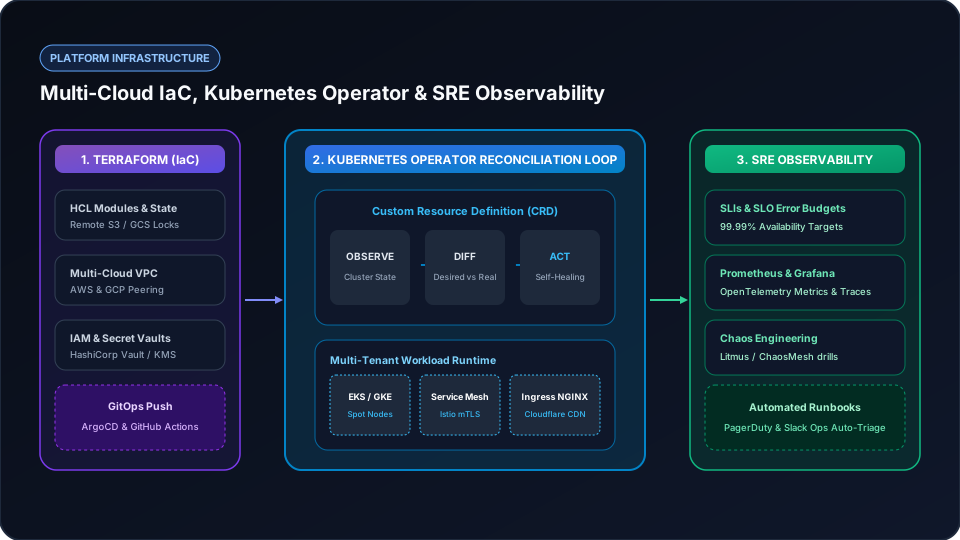
Multi-Cloud GitOps, Kubernetes Operator & SRE Pipeline
Complete infrastructure flow from declarative Terraform HCL code and ArgoCD GitOps sync to Kubernetes custom controller reconciliation loops and Prometheus SLO alerts.
Terraform Multi-Cloud IaC
Modular declarative infrastructure managing AWS VPCs, GCP subnets, IAM roles, and HashiCorp Vault secrets with state locking.
Kubernetes Operator SDK
Custom controllers written in Go/Python that observe desired state, diff cluster telemetry, and reconcile self-healing workloads.
GitOps Continuous Delivery
ArgoCD maintaining immutable cluster state synced directly from version-controlled Git repositories.
SRE Error Budgets
Tracking Service Level Indicators (SLIs) and 99.99% availability targets using Prometheus, OpenTelemetry, and Grafana.
Structured Week-by-Week Learning Syllabus
Focus on build-by-doing milestones rather than passive video lectures.
Phase 1: Declarative Multi-Cloud Infrastructure (Terraform)
- Terraform HCL syntax, state locking in AWS S3 with DynamoDB
- Reusable modules, workspaces, and multi-region VPC peering
- Managing IAM least-privilege policies, security groups, and HashiCorp Vault
Phase 2: Kubernetes Operators & GitOps CI/CD
- CKA-level Kubernetes primitives: Deployments, StatefulSets, Ingress, mTLS
- Building custom Kubernetes Operators using Operator SDK / Kubebuilder
- ArgoCD GitOps synchronization, Helm charts, and canary release strategies
Phase 3: SRE Observability, SLIs/SLOs & Chaos Engineering
- Prometheus metrics scraping, PromQL queries, and custom Grafana dashboards
- OpenTelemetry distributed tracing across microservices
- SLI/SLO error budget alerts, PagerDuty on-call escalation, and Litmus chaos drills
Top Interview Questions & Answers
Q1: How does a Kubernetes Operator differ from a standard Kubernetes Controller?
A standard controller (like ReplicaSetController) manages built-in Kubernetes resources. A Kubernetes Operator is an application-specific controller that extends the Kubernetes API using Custom Resource Definitions (CRDs) to encapsulate human operational knowledge (such as stateful database clustering, auto-backups, and zero-downtime schema upgrades).
Q2: How do you handle Terraform state file drift in a large engineering team?
Use remote state storage with distributed state locking (e.g. AWS S3 + DynamoDB or Terraform Cloud), enforce GitOps pull-request workflows where plans are automatically calculated via Atlantis/Spacelift, and run periodic drift-detection cron jobs.
Frequently Asked Questions
Which cloud provider is most in demand in India: AWS or GCP?
AWS holds the largest market share in Indian enterprise IT, while GCP has rapid growth in data-heavy startups and AI workloads. Multi-cloud proficiency (AWS + GCP via Terraform) is the most sought-after combination.
Is CKA (Certified Kubernetes Administrator) mandatory to get hired?
While not mandatory, having CKA certification guarantees interview callbacks from tier-1 MNCs and GCCs in Bengaluru and Pune.
Target Job Roles
Cloud Platform Engineer
Demand: Very HighSite Reliability Engineer (SRE)
Demand: Very HighKubernetes Infrastructure Specialist
Demand: HighRelated Career Tracks
Not sure if Cloud Platform Engineering & SRE is right for you?
Take our 30-second career quiz to find your highest-ROI match.
Start Free Quiz