EV Powertrain & Battery Management Systems (BMS)
The electric mobility revolution is sweeping across two-wheelers, passenger cars, and commercial fleets in India and globally. Master the core engineering of electric vehicle powertrains, Lithium-ion cell chemistry (LFP/NMC), Battery Management Systems (BMS) hardware and active cell balancing, traction inverter thermodynamics, and international fast-charging communication protocols (CCS2, Type-2, and GB/T).

🇮🇳 Indian Market Benchmark
Why This Skill Pays Off in 2026
EV Powertrain, BMS Control Loop & High-Power Charging Flow
Four-stage electric vehicle power transmission architecture: HV battery pack with active cell balancing, SiC traction inverter, permanent magnet motor, and CCS2 DC fast charging.
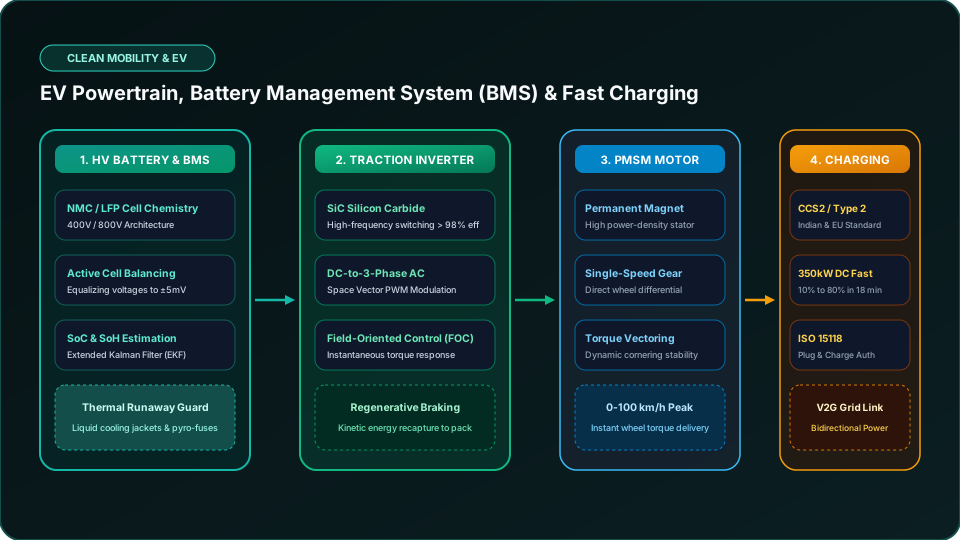
HV Battery & Cell Balancing
LFP/NMC cell stacks managed by BMS microcontrollers equalizing voltages to ±5mV and calculating State-of-Charge (SoC).
Silicon Carbide Traction Inverter
High-frequency DC-to-3-Phase AC power conversion with >98% thermal efficiency and regenerative braking.
Permanent Magnet Motor
Instantaneous torque delivery, field-oriented control (FOC), and dynamic cornering stability.
Fast-Charging Standards
CCS2 and Type-2 standards supporting 350kW DC fast-charging with ISO 15118 plug-and-charge cryptographic handshakes.
Structured Week-by-Week Learning Syllabus
Focus on build-by-doing milestones rather than passive video lectures.
Phase 1: Lithium-Ion Battery Chemistry & Pack Architecture
- Lithium iron phosphate (LFP) vs Nickel Manganese Cobalt (NMC) trade-offs
- Series-parallel cell sizing, busbar design, and packaging constraints
- Thermal runaway mechanics, propagation prevention, and liquid cooling plates
Phase 2: BMS Architecture & State Estimation Algorithms
- Passive vs Active cell voltage balancing topologies
- State of Charge (SoC) and State of Health (SoH) calculation using Extended Kalman Filters
- Over-voltage, under-voltage, over-current, and isolation resistance fault protection
Phase 3: Traction Inverters, Motor Control & Charging Protocols
- Silicon Carbide (SiC) vs IGBT traction inverter thermodynamics and Space Vector PWM
- Field-Oriented Control (FOC) of Permanent Magnet Synchronous Motors (PMSM)
- CCS2 / Type-2 charging communication protocols, PLC controllers, and ISO 15118 standards
Top Interview Questions & Answers
Q1: What is the fundamental difference between Passive and Active Cell Balancing in a BMS?
Passive balancing burns off excess energy from higher-voltage cells as heat through bleed resistors until all cells match the lowest cell. Active balancing uses capacitive or inductive charge-shuttling circuits to transfer energy from higher-voltage cells to lower-voltage cells, conserving pack energy, generating less thermal heat, and maximizing total vehicle range.
Q2: Why is LFP chemistry preferred for electric two-wheelers and buses in Indian tropical climates?
LFP (Lithium Iron Phosphate) has superior thermal stability with a thermal runaway threshold around ~270°C (compared to ~210°C for NMC), exceptional cycle life (3,000+ cycles vs 1,500 for NMC), and uses non-toxic iron and phosphate without volatile cobalt, making it much safer in high ambient Indian temperatures (45°C+).
Frequently Asked Questions
Which Indian companies hire EV powertrain and BMS engineers?
Automotive OEMs (Tata Motors, Mahindra Electric, Ola Electric, Ather Energy), global Tier-1 suppliers (Bosch India, Continental, Valeo), and battery gigafactories (Exide, Amara Raja).
Is MATLAB and Simulink proficiency required for EV engineering?
Yes! Model-Based Development (MBD) in MATLAB/Simulink is standard for control algorithm verification and auto-code generation for automotive ECUs.
Target Job Roles
BMS Hardware / Firmware Engineer
Demand: Very HighEV Powertrain Systems Engineer
Demand: HighBattery Pack Thermal Analyst
Demand: HighRelated Career Tracks
Not sure if EV Powertrain & Battery Management Systems (BMS) is right for you?
Take our 30-second career quiz to find your highest-ROI match.
Start Free Quiz