IoT & Embedded Systems (Rust & Edge AI)
The Internet of Things has advanced from simple sensor data logging into real-time on-device intelligence. Master bare-metal embedded programming with memory-safe Rust (#![no_std]), FreeRTOS multitasking on ESP32 microcontrollers, quantized TinyML neural network execution directly on MCU silicon, and automotive CAN bus communication compliant with ISO 26262 functional safety standards.

🇮🇳 Indian Market Benchmark
Why This Skill Pays Off in 2026
Edge AI Microcontroller Pipeline: Sensors to In-Vehicle CAN Bus
Hardware architecture showing physical sensor sampling, bare-metal Rust memory safety, on-device TinyML neural inference, and CAN Bus 2.0B automotive telemetry.
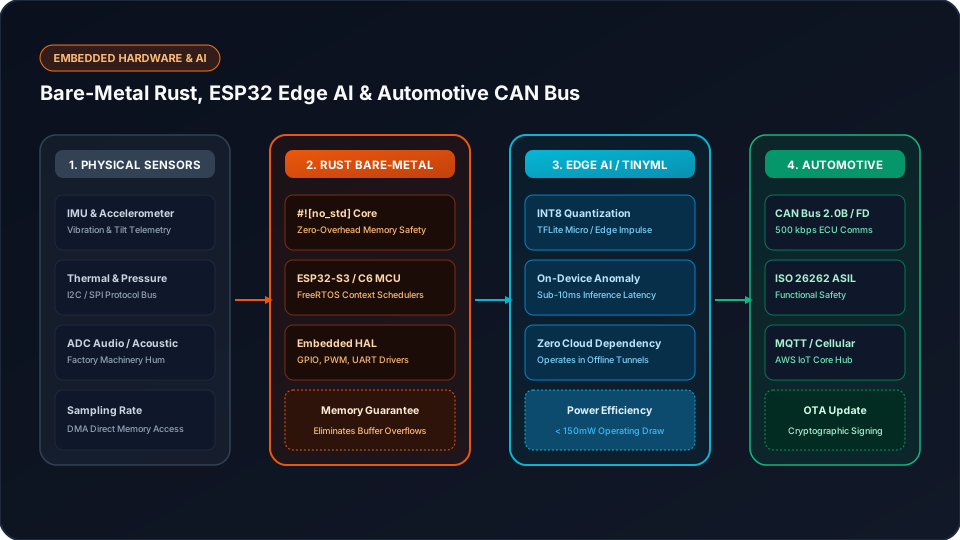
Physical Sensor Ingestion
Sampling accelerometer, temperature, and acoustic signals over high-speed I2C, SPI, and DMA hardware channels.
Bare-Metal Rust Firmware
Zero-cost abstractions and compile-time memory safety eliminating pointer errors and buffer overflows without an OS runtime.
TinyML Edge Inference
Executing INT8 quantized neural models on ESP32-S3 silicon with sub-10ms response times and zero cloud dependencies.
Automotive CAN Bus
Deterministic vehicle electronic control unit (ECU) messaging compliant with ISO 26262 ASIL safety protocols.
Structured Week-by-Week Learning Syllabus
Focus on build-by-doing milestones rather than passive video lectures.
Phase 1: Bare-Metal Rust & Microcontroller Fundamentals
- Rust memory ownership, borrowing, and no_std bare-metal fundamentals
- ESP32 hardware architecture, GPIO, UART, SPI, I2C driver writing
- FreeRTOS task scheduling, queues, mutexes, and interrupt handlers (ISR)
Phase 2: TinyML & On-Device Edge AI Inference
- Data collection, feature extraction (FFT spectral analysis), and model training
- Quantizing models to INT8 using TensorFlow Lite for Microcontrollers (TFLM)
- Deploying anomaly detection on ESP32-S3 vector instructions
Phase 3: Automotive Electronics, CAN Bus & Connected IoT
- CAN Bus 2.0B / CAN-FD physical layer, transceivers, and DBC file parsing
- ISO 26262 functional safety, watchdog timers, and fail-safe state machines
- Cellular / MQTT telemetry streaming to AWS IoT Core with cryptographic OTA updates
Top Interview Questions & Answers
Q1: Why is Rust gaining massive adoption over traditional C in embedded and automotive systems?
Over 70% of high-severity vulnerabilities in C/C++ embedded systems stem from memory safety bugs (buffer overflows, dangling pointers, race conditions). Rust guarantees memory safety and thread safety at compile-time with zero runtime garbage-collection overhead, dramatically reducing safety-critical recalls in automotive and medical hardware.
Q2: How does INT8 quantization work in TinyML edge models?
INT8 quantization maps 32-bit floating-point weights and activation values into 8-bit signed integers through scaling and zero-point offsets. This reduces model memory footprint by 75% and enables 2x-4x faster integer SIMD execution on microcontrollers with minimal accuracy degradation.
Frequently Asked Questions
Do I need expensive hardware lab equipment to learn embedded systems?
An affordable ESP32-S3 development board (₹600–₹1,200), a couple of basic sensor modules (MPU6050, DHT22), and an inexpensive USB logic analyzer (₹500) are all that is needed to build a complete portfolio.
Are there jobs for Rust embedded engineers in India?
Yes! EV leaders like Ather, Ola, Tata Motors, and global tier-1 automotive suppliers (Bosch, Continental) are aggressively hiring Rust engineers for vehicle telematics and battery controllers.
Target Job Roles
Embedded Software Engineer (Rust / C++)
Demand: Very HighEdge AI / TinyML Engineer
Demand: HighAutomotive Embedded Systems Specialist
Demand: HighRelated Career Tracks
Not sure if IoT & Embedded Systems (Rust & Edge AI) is right for you?
Take our 30-second career quiz to find your highest-ROI match.
Start Free Quiz