AI Agents & LLM Applications Engineering
Autonomous AI Agents and LLM Applications represent the highest-paying software engineering frontier in 2026. Transition from passive prompt scripts to autonomous multi-agent networks powered by LangGraph, CrewAI, AutoGen, and Anthropic's Model Context Protocol (MCP). Learn to equip foundation models with dynamic tool-calling capabilities, pgvector semantic search, structured output contracts via Pydantic, and low-latency enterprise inference via vLLM.

🇮🇳 Indian Market Benchmark
Why This Skill Pays Off in 2026
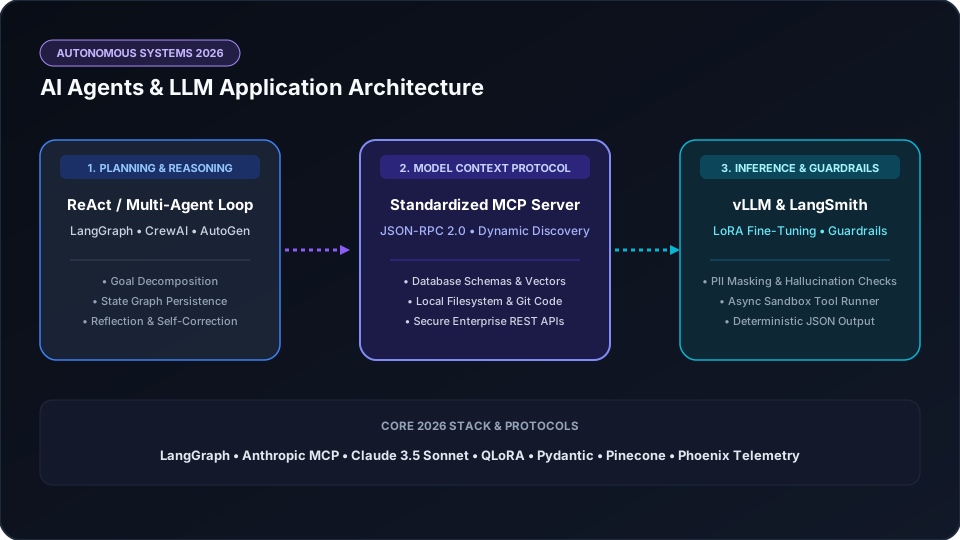
Autonomous Multi-Agent & Model Context Protocol (MCP) Architecture
End-to-end telemetry illustrating goal decomposition, state graph execution, standardized MCP tool discovery, and parameter-efficient SLM inference.
Multi-Agent State Graph
LangGraph and CrewAI coordinate specialized planner, researcher, coder, and critic agents with persistent memory and reflection loops.
Model Context Protocol (MCP)
Universal open protocol exposing local filesystems, PostgreSQL databases, and internal APIs as discoverable tools over JSON-RPC 2.0.
Structured Schema & Validation
Enforcing deterministic JSON payloads with Pydantic and Instructor, preventing schema drift and hallucinated responses.
Guardrails & Telemetry
Real-time observability via LangSmith and Phoenix to track token latency, multi-hop costs, and PII masking.
Structured Week-by-Week Learning Syllabus
Focus on build-by-doing milestones rather than passive video lectures.
Phase 1: Advanced Prompting, Function Calling & Structured Outputs
- Few-shot chain-of-thought, self-consistency sampling, and structured output parsing
- Enforcing strict JSON schemas using Pydantic, Instructor, and Outlines
- Anthropic & OpenAI tool-calling semantics, error recovery, and parameter validation
Phase 2: RAG Vector Pipelines & Model Context Protocol (MCP) Servers
- Hybrid search in pgvector and Qdrant (Dense Vector Embeddings + BM25 Sparse Lexical)
- Building custom MCP Clients and Servers in TypeScript & Python for live SQL and Git access
- Context window management, chunking strategies, and dynamic reranking with Cohere
Phase 3: Autonomous Multi-Agent Orchestration & SLM Fine-Tuning
- ReAct and Plan-and-Solve architectures using LangGraph and CrewAI
- Fine-tuning Small Language Models (Llama-3, Phi-3, Mistral) with QLoRA & Unsloth
- High-throughput deployment using vLLM, TensorRT-LLM, and LangSmith evaluation suites
Top Interview Questions & Answers
Q1: What is the Model Context Protocol (MCP) and how does it revolutionize LLM tool calling?
Model Context Protocol (MCP) is an open standard created by Anthropic using JSON-RPC 2.0. Rather than hardcoding custom API wrappers for every database and tool, MCP provides a unified client-server architecture. An AI client can dynamically discover available tools, read file/context resources, and execute functions across interchangeable enterprise MCP servers safely.
Q2: How do you prevent infinite loops and token explosion in autonomous ReAct agents?
You implement strict recursion limits (max iteration counters), stateful checkpointing with LangGraph, budget caps on token spend per workflow, deterministic stop conditions, and human-in-the-loop (HITL) pause mechanisms for irreversible tool actions.
Frequently Asked Questions
Do I need a PhD in Machine Learning to build enterprise AI Agent apps?
No. Modern AI engineering focuses on distributed systems engineering, API integration, data modeling, MCP contracts, and prompt architecture rather than training neural networks from scratch.
What models are currently dominating enterprise agent development?
Claude 3.5 Sonnet leads for complex reasoning and tool execution, alongside OpenAI GPT-4o, with fine-tuned open-source models like Llama-3.1 70B and Mistral Large utilized for on-premise private deployments.
Target Job Roles
Generative AI Engineer
Demand: Very HighAI Agent Systems Architect
Demand: Very HighAI Automation Consultant (USD Remote)
Demand: HighRelated Career Tracks
Not sure if AI Agents & LLM Applications Engineering is right for you?
Take our 30-second career quiz to find your highest-ROI match.
Start Free Quiz