Financial Accounting & Ledger Operations
Financial Accounting is the universal language of business. Master the dual-aspect convention, journalizing transactions, general ledger posting, debit-credit controls, month-end accrual adjustments, trial balance reconciliation, and drafting balance sheets and P&L statements.

🇮🇳 Indian Market Benchmark
Core Track Highlights
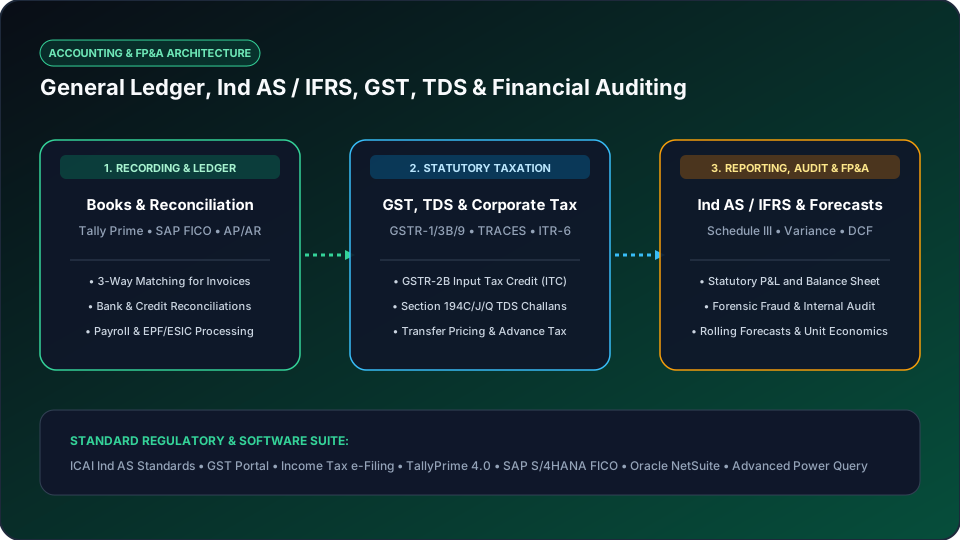
Double-Entry Accounting & Financial Reporting Lifecycle
Source documents, journal entries, ledger posting, trial balance, and Schedule III financial statements.
Source Documentation
Auditing invoices, purchase orders, bank receipts, and voucher generation.
General Ledger & Accruals
Posting double-entry transactions, depreciation, and prepaid/accrued expense adjustments.
Trial Balance Reconciliation
Verifying mathematical equality of debit and credit balances prior to closing.
Schedule III Statements
Generating Balance Sheet, Statement of Profit & Loss, and Cash Flow Statement.
Structured Phase-by-Phase Syllabus
Focus on build-by-doing milestones rather than passive video consumption.
Phase 1: Dual-Entry Journalizing & Ledger Operations
- Accounting equation: Assets = Liabilities + Equity and Golden Rules of Accounting
- Recording purchase, sales, receipt, payment, and contra vouchers in TallyPrime and Zoho Books
- General Ledger posting, sub-ledger control accounts, and subsidiary cash book management
Phase 2: Month-End Adjustments & Financial Statement Preparation
- Adjusting entries: Accruals, prepayments, depreciation (SLM vs WDV), and bad debt provisions
- Bank Reconciliation Statements (BRS) with automated ledger matching
- Drafting Balance Sheet, P&L Statement, and Cash Flow Statement (AS-3 / Ind AS 7)
Technical Interview Questions & Answers
Q1: What is the Golden Rule of Accounting for Real, Personal, and Nominal accounts?
Real Accounts: Debit what comes in, Credit what goes out. Personal Accounts: Debit the receiver, Credit the giver. Nominal Accounts: Debit all expenses and losses, Credit all incomes and gains.
Frequently Asked Questions
What is the difference between Single-Entry and Double-Entry bookkeeping?
Single-entry only tracks cash flows and personal accounts; Double-entry records every transaction with equal and opposite debit and credit entries, ensuring complete balance sheet and income statement integrity.
Target Job Roles
Accountant / Accounts Executive
Demand: Very HighSenior Accountant / Accounts Manager
Demand: HighRelated Career Tracks
Need a Personalized Career Plan?
Take our 20+ Signal Career Compass to assess aptitude and discover suitable roadmaps.
Start Career Compass