Ind AS & IFRS Accounting Standards
Ind AS (converged with IFRS) governs financial reporting for all Indian listed companies, large unlisted entities, and multinational enterprises. Master Ind AS 115 (Revenue from Contracts with Customers - 5-Step Model), Ind AS 116 (Right-of-Use Leases), Ind AS 109 (Expected Credit Loss ECL & Financial Instruments), Ind AS 12 (Deferred Taxes), and Business Combinations (Ind AS 103).

🇮🇳 Indian Market Benchmark
Core Track Highlights
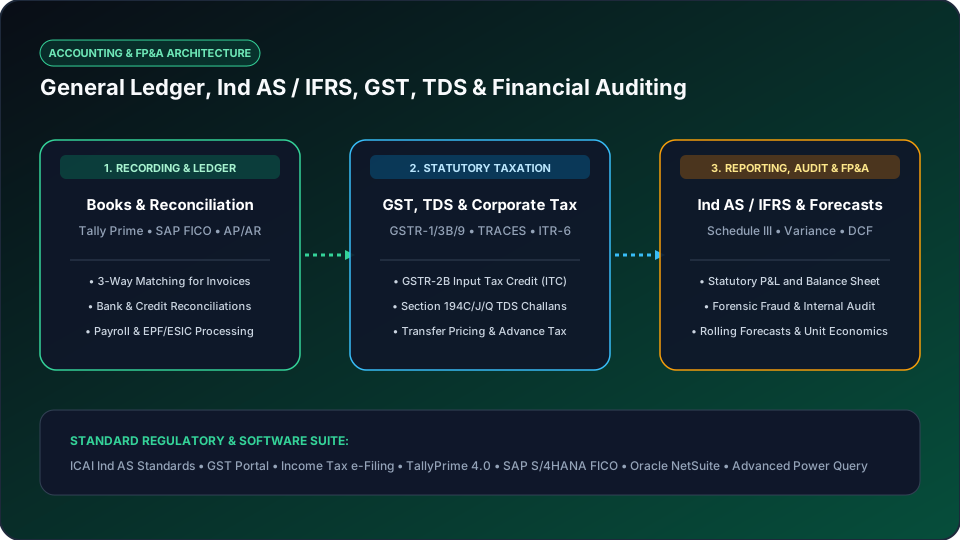
Ind AS & IFRS Financial Reporting Architecture
Standard evaluation, fair value measurement, balance sheet adjustments, and comprehensive footnote disclosure.
Ind AS 115 Revenue
5-step model identifying performance obligations, transaction price, and over-time recognition.
Ind AS 116 Leases
Recognizing Right-of-Use (ROU) assets and Lease Liabilities on balance sheet.
Ind AS 109 Financial Instruments
Amortized cost, FVTOCI, FVTPL, and 3-stage Expected Credit Loss (ECL) provisioning.
Ind AS 103 Business Combinations
Purchase price allocation (PPA), fair valuation of intangibles, and Goodwill calculation.
Structured Phase-by-Phase Syllabus
Focus on build-by-doing milestones rather than passive video consumption.
Phase 1: Revenue Recognition (Ind AS 115) & Leases (Ind AS 116)
- Ind AS 115 5-Step Model: Contract identification, performance obligations, transaction price, allocation, and recognition timing
- Accounting for contract assets, contract liabilities, warranties, and variable consideration
- Ind AS 116 Leases: Lessee accounting, Right-of-Use (ROU) asset amortization, lease liability discounting, and transition adjustments
Phase 2: Financial Instruments (Ind AS 109) & Fair Value (Ind AS 113)
- Classification of financial assets & liabilities: Amortized cost, FVTOCI, and FVTPL
- 3-Stage Expected Credit Loss (ECL) provisioning model for trade receivables and loan portfolios
- Fair Value hierarchy (Level 1, 2, 3 inputs) under Ind AS 113 and embedded derivative accounting
Phase 3: Business Combinations (Ind AS 103) & Consolidation (Ind AS 110)
- Ind AS 103 Business Combinations: Acquisition method, Purchase Price Allocation (PPA), and Goodwill / Capital Reserve computation
- Consolidated Financial Statements under Ind AS 110: Elimination of intra-group transactions and Non-Controlling Interest (NCI)
- Deferred Tax Assets / Liabilities under Ind AS 12 (Balance sheet liability method)
Technical Interview Questions & Answers
Q1: Explain the 5-Step Model of Revenue Recognition under Ind AS 115 / IFRS 15.
The 5 steps are: (1) Identify the contract with a customer, (2) Identify the separate performance obligations in the contract, (3) Determine the transaction price, (4) Allocate the transaction price to the distinct performance obligations based on relative standalone selling prices, and (5) Recognize revenue when (or as) the entity satisfies each performance obligation (either over time or at a point in time).
Frequently Asked Questions
What is the key difference between Indian GAAP (AS) and Ind AS?
Indian GAAP was rule-based and historical-cost focused; Ind AS is principle-based, fair-value driven, and converged with international IFRS standards with extensive balance-sheet recognition (e.g. lease assets, ECL, fair valuation of investments).
Target Job Roles
Ind AS / IFRS Technical Accounting Specialist
Demand: Very HighFinancial Reporting Manager / Controller
Demand: HighRelated Career Tracks
Need a Personalized Career Plan?
Take our 20+ Signal Career Compass to assess aptitude and discover suitable roadmaps.
Start Career Compass