AI Agent Evaluation & LLM Observability
Building AI agents is only half the battle—evaluating and monitoring them in production determines enterprise viability. Master LLM evaluation frameworks (Ragas, TruLens, DeepEval), synthetic test dataset generation, multi-hop agent tracing, hallucination rate quantification, token latency profiling, and semantic drift detection with LangSmith and Arize Phoenix.

🇮🇳 Indian Market Benchmark
Core Track Highlights
LLM Observability & Continuous Agent Evaluation Pipeline
Prompt execution, OpenTelemetry span capture, Ragas metric evaluation, and automated regression benchmarking.
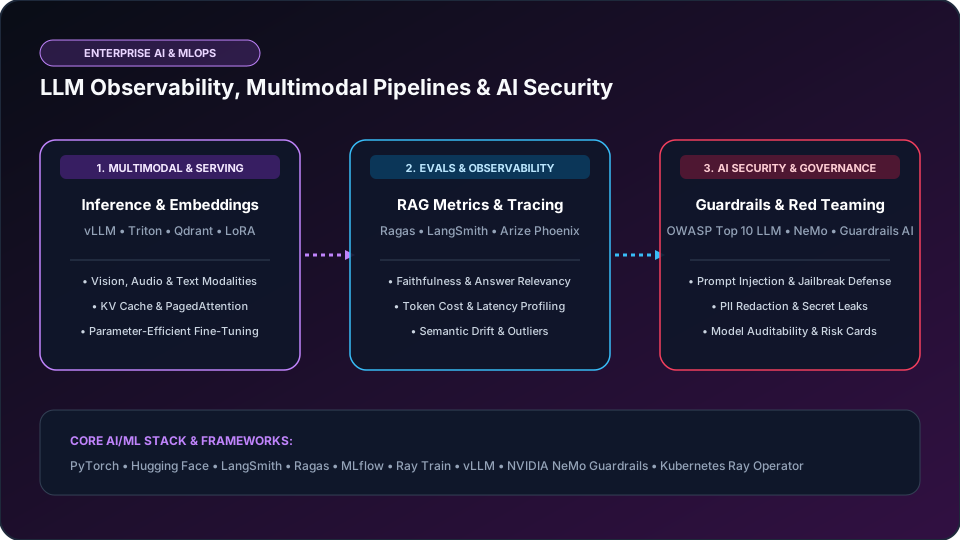
RAG Triad Metrics
Quantifying Context Relevance, Groundedness (Faithfulness), and Answer Relevance.
Distributed Tracing Spans
Capturing token latency, cost, and tool-call payload execution across multi-agent loops.
Synthetic Benchmark Suites
Generating hundreds of edge-case evaluation QA pairs using LLM-as-a-Judge.
CI/CD Regression Gates
Failing automated pull requests if hallucination score exceeds 2% or latency spikes.
Structured Phase-by-Phase Syllabus
Focus on build-by-doing milestones rather than passive video consumption.
Phase 1: Metric Foundations & RAG Triad Evaluation
- The RAG Triad: Faithfulness, Answer Relevance, and Context Precision/Recall
- Implementing Ragas and DeepEval for automated offline evaluation suites
- LLM-as-a-Judge prompting patterns, calibration against human gold standards, and G-Eval scoring
Phase 2: Production Observability, Tracing & Cost Telemetry
- Instrumenting LangChain, LangGraph, and LlamaIndex applications with OpenTelemetry spans
- LangSmith and Arize Phoenix setup: Tracing multi-agent tool calls, latency bottlenecks, and token cost tracking
- Online evaluation: User thumbs-up/down telemetry and real-time guardrail failure alerts
Phase 3: CI/CD Quality Gates & Semantic Drift Detection
- Integrating automated LLM eval suites into GitHub Actions CI/CD deployment pipelines
- Detecting embedding semantic drift, prompt regression, and out-of-distribution user queries
- Red-teaming datasets: Testing jailbreak resilience and PII leakage during automated builds
Technical Interview Questions & Answers
Q1: How do you calculate Faithfulness and Answer Relevance in a RAG evaluation pipeline using Ragas?
Faithfulness measures whether the generated answer can be completely grounded in the retrieved context (Statements in answer inferred from context / Total statements in answer). Answer Relevance uses an LLM to generate hypothetical questions from the generated response and computes embedding cosine similarity against the original user query, measuring whether the response directly addresses the question without fluff.
Frequently Asked Questions
Why is LLM-as-a-Judge preferred over traditional BLEU or ROUGE metrics?
BLEU and ROUGE rely on exact n-gram overlap, failing completely when an LLM gives a semantically identical answer using different vocabulary. LLM-as-a-Judge evaluates semantic understanding, reasoning, and nuanced factual accuracy.
Target Job Roles
AI Evaluation & Observability Engineer
Demand: Very HighStaff AI Systems Architect
Demand: HighRelated Career Tracks
Need a Personalized Career Plan?
Take our 20+ Signal Career Compass to assess aptitude and discover suitable roadmaps.
Start Career Compass