AI Security, Red Teaming & LLM Defense
AI Security protects enterprise foundation models from adversarial attacks. Master OWASP Top 10 for LLMs, direct and indirect prompt injection defense, red teaming foundation models, PII masking, toxic content filtering, model extraction defenses, and deploying NVIDIA NeMo Guardrails and Llama Guard.

🇮🇳 Indian Market Benchmark
Core Track Highlights
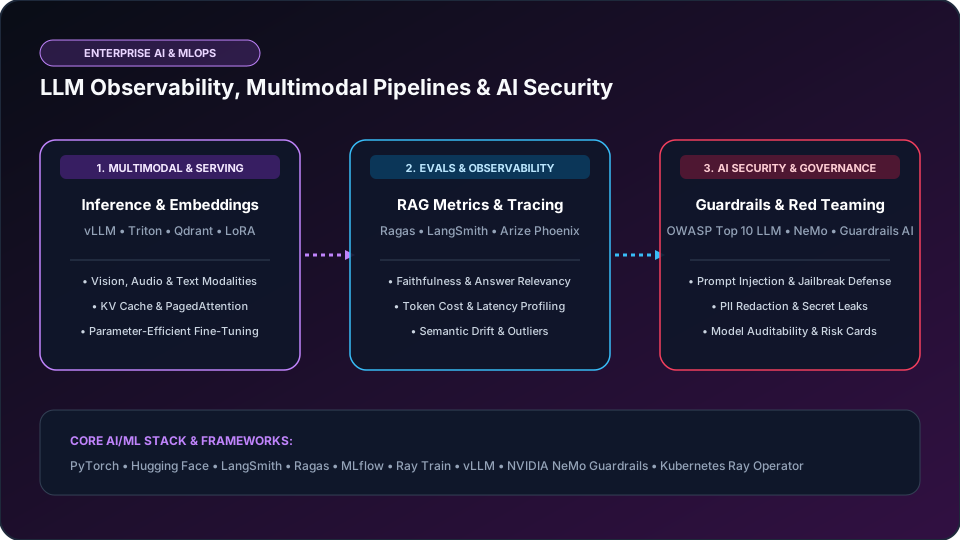
Enterprise AI Security & Guardrail Defense Architecture
Input sanitization, prompt injection detection, vector access controls, and output toxicity filtering.
Prompt Injection Defense
Detecting adversarial system-override tokens and invisible Unicode payloads.
Indirect Injection Sanitization
Sanitizing third-party scraped web pages and emails before LLM ingestion.
NeMo Guardrails Execution
Enforcing topical rails, dialog flow constraints, and factual verification.
PII Redaction & Leaks
Real-time token anonymization preventing confidential model extraction.
Structured Phase-by-Phase Syllabus
Focus on build-by-doing milestones rather than passive video consumption.
Phase 1: OWASP Top 10 for LLMs & Adversarial Prompting
- OWASP Top 10 for Large Language Model Applications (LLM01 Prompt Injection to LLM10 Model Theft)
- Direct jailbreak taxonomies: Roleplay persona switches, base64 obfuscation, multi-turn crescendo attacks
- Indirect prompt injection in RAG pipelines: Malicious payloads hidden in PDFs, emails, and web search results
Phase 2: Programmable Guardrails & Input/Output Firewalls
- Deploying NVIDIA NeMo Guardrails (Colang scripts for topical rails, moderation, and fact-checking)
- Llama Guard 3 and Presidio for real-time PII anonymization and toxic response blocking
- Defense-in-depth: Dual-LLM validation architectures (Untrusted Content vs Decision-Maker Model)
Phase 3: Model Inversion, Poisoning & AI Security Governance
- Training data extraction attacks and membership inference defense
- RAG data poisoning: Protecting vector databases from adversarial document injection
- AI governance risk cards: Threat modeling enterprise AI agents and red team reporting
Technical Interview Questions & Answers
Q1: What is an Indirect Prompt Injection attack and how do you mitigate it in a RAG system?
Indirect Prompt Injection occurs when an attacker places adversarial instructions into an external data source (a website, email, or resume) that the LLM later retrieves via RAG or web search. When the LLM ingests this untrusted content, the hidden prompt overrides the system instructions (e.g. instructing the agent to exfiltrate user data). Mitigation includes: isolating untrusted data in separate context blocks, using dual-model architectures, and deploying input guardrails to scan retrieved chunks before context assembly.
Frequently Asked Questions
What background is best for transitioning into AI Security?
A background in cybersecurity (SOC, AppSec, PenTesting) or software engineering combined with hands-on prompt engineering and transformer model understanding.
Target Job Roles
AI Security Engineer / Red Teamer
Demand: Very HighHead of AI Trust, Safety & Security
Demand: HighRelated Career Tracks
Need a Personalized Career Plan?
Take our 20+ Signal Career Compass to assess aptitude and discover suitable roadmaps.
Start Career Compass