Cloud FinOps & Multi-Cloud Cost Optimization
Cloud FinOps (Financial Operations) is the high-visibility discipline combining cloud infrastructure architecture, finance, and engineering culture. Master how to implement the FinOps Foundation Framework (Inform, Optimize, Operate). Unify multi-cloud billing using the new FOCUS (FinOps Open Cost & Usage Specification) standard, allocate container costs down to individual Kubernetes pods with Kubecost, architect 40%+ savings via Reserved Instances and Spot Fleets, and integrate PR-level cost estimates with Infracost.

🇮🇳 Indian Market Benchmark
Why This Skill Pays Off in 2026
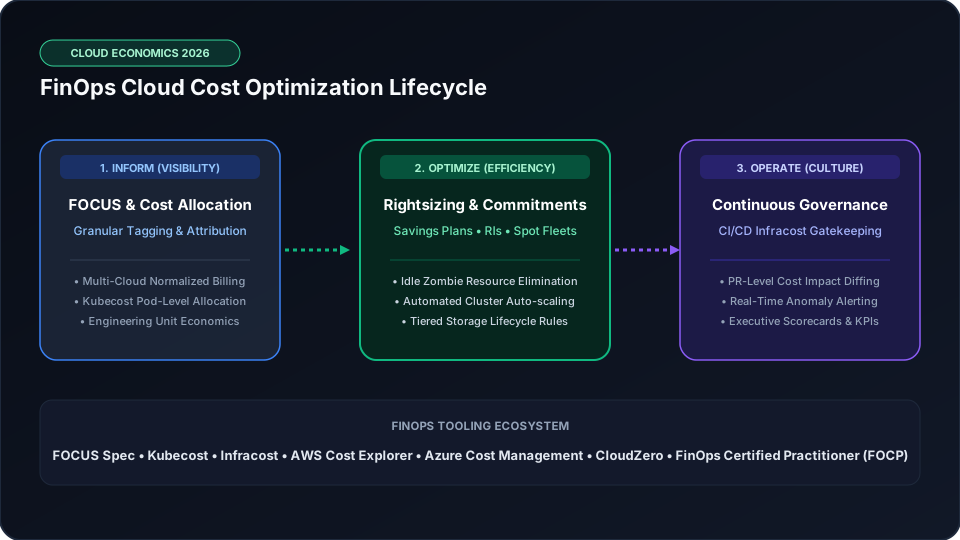
Cloud FinOps Optimization & Governance Lifecycle
Continuous loop showing multi-cloud FOCUS cost normalization, pod-level container allocation, architectural rightsizing, and CI/CD cost gatekeeping.
Inform & Visibility (FOCUS)
Normalizing complex multi-cloud invoices (AWS, Azure, GCP) using the open FOCUS specification for unified reporting.
Granular Container Allocation
Utilizing Kubecost and OpenCost to attribute shared Kubernetes cluster expenditures directly to engineering product teams.
Architectural Optimization
Eliminating zombie resources, automated instance rightsizing, storage tier lifecycle policies, and Spot fleet orchestration.
Operate & Continuous Governance
Integrating Infracost into GitHub Actions to display real-time monthly dollar cost diffs before merging pull requests.
Structured Week-by-Week Learning Syllabus
Focus on build-by-doing milestones rather than passive video lectures.
Phase 1: Cloud Billing Mechanics, Tagging Taxonomy & FOCUS Standard
- AWS Cost and Usage Reports (CUR), Azure Cost Exports, and GCP BigQuery billing schemas
- Implementing normalized multi-cloud reporting using the FOCUS 1.0 specification
- Enforcing comprehensive organizational tagging policies and cost-center attribution
Phase 2: Kubernetes Container Allocation & Infrastructure Rightsizing
- Deploying Kubecost and OpenCost for pod, namespace, and label-based cost attribution
- Architecting commitments: Savings Plans vs Reserved Instances (RIs) vs Spot Fleets
- Eliminating unattached EBS volumes, idle NAT Gateways, and untiered S3 storage
Phase 3: CI/CD Cost Gatekeeping, Unit Economics & FinOps Culture
- Integrating Infracost into CI/CD pipelines to display pull-request cloud cost diffs
- Defining engineering Unit Economics (Cost per active user, Cost per search transaction)
- Preparing for the FinOps Certified Practitioner (FOCP) exam
Top Interview Questions & Answers
Q1: What is the FOCUS (FinOps Open Cost & Usage Specification) standard and why is it important?
FOCUS is an open-source standard created by the FinOps Foundation to normalize billing datasets across cloud providers (AWS, Microsoft Azure, Google Cloud, OCI, and SaaS vendors). Previously, every cloud used different naming conventions (e.g., UnblendedCost vs EffectiveCost, ResourceId vs InstanceName). FOCUS creates a single unified schema so enterprise FinOps teams can query multi-cloud spend with standard SQL without custom ETL translation.
Q2: How do you allocate shared Kubernetes infrastructure costs to different product teams?
You deploy Kubecost/OpenCost, which measures real-time CPU, RAM, GPU, and PV storage requests vs actual usage per namespace and container label. Shared overhead (control plane, monitoring, ingress controllers) is proportionally allocated based on each team's fractional resource consumption.
Frequently Asked Questions
Do I need a finance degree to become a FinOps Engineer?
No. Most successful FinOps professionals come from DevOps, Cloud Engineering, or Data Analytics backgrounds because the hardest part is understanding cloud architecture, autoscaling, and container dynamics.
Which certification is most recognized globally?
The FinOps Certified Practitioner (FOCP) and FinOps Certified Professional by the Linux Foundation / FinOps Foundation.
Target Job Roles
Cloud FinOps Analyst / Engineer
Demand: HighSenior FinOps Architect
Demand: HighCloud Economics & Optimization Manager
Demand: Moderate to HighRelated Career Tracks
Not sure if Cloud FinOps & Multi-Cloud Cost Optimization is right for you?
Take our 30-second career quiz to find your highest-ROI match.
Start Free Quiz